
Rediscovery of a French masterpiece: Napoleon Bonaparte at Arcole by Antoine-Jean Gros
On Wednesday, March 25th, 2026, at Artcurial’s Old Master & 19th Century Drawings auction, bidders will have the opportunity to compete for a drawing by Antoine-Jean Gros depicting General Bonaparte’s capture of the Bridge of Arcole on November 15th, 1796. The work is a preparatory study for the celebrated painting Bonaparte au pont d’Arcole, now in the collection of the Palace of Versailles.
This historic drawing was made on December 7th, 1796, in Milan, during a short posing session organised by Joséphine de Beauharnais. Baron Gros was 25 years old at the time, and Bonaparte was 27. Before returning to the front, Bonaparte agreed to spend a few minutes with this painter, who was as young and hungry for glory as he was. With a few strokes of his pencil, the artist captured the impetuous general's features with striking accuracy. All the romantic passion of the victorious military leader is wonderfully rendered in this drawing. The hero's face shows an unparalleled determination to win. Bonaparte's gaze is as striking as Gros's execution of the drawing, which confirms, with this work created well before Delacroix, his place as the founding father of French Romanticism.
Our unique drawing boasts an impeccable history and origin. It was given directly by Baron Gros to his friend, the painter Vincenzo Camuccini (1771-1844), and has been carefully preserved within his family ever since. The rediscovery of this historic artwork among his descendants is already one of the major events of 2026 for the French art market and a great privilege for Artcurial's Old Master & 19th Century Art department.
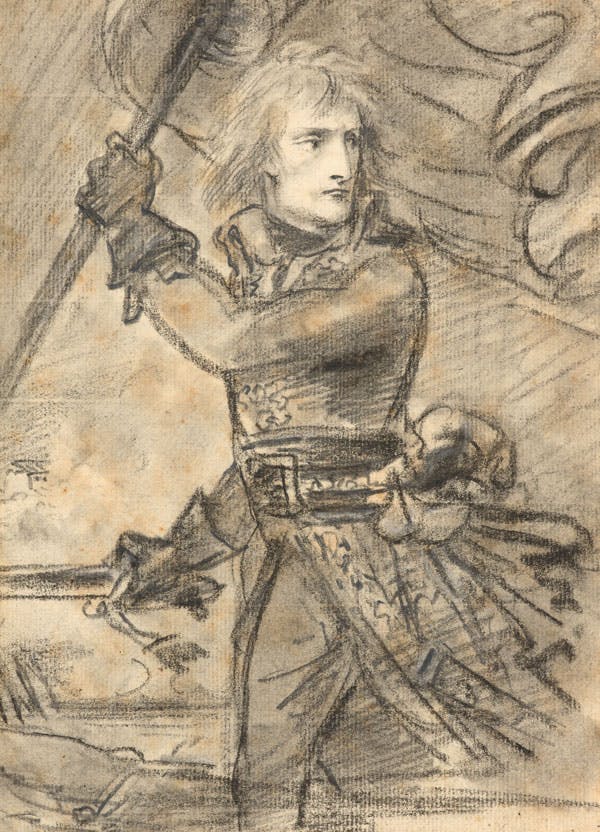
Antoine-Jean Gros, dit baron Gros (1771-1835)
General Bonaparte at the Bridge of Arcole, 15 November 1796
Black chalk, stumping
Estimate: €200,000 - 300,000
On December 7th, 1796, when Jean-Antoine Gros was granted a few minutes to pose in a palace in Milan, Bonaparte had just experienced, three weeks earlier, the decisive episode of the Battle of Arcole. This major confrontation in the Italian campaign sealed the birth of the Napoleonic legend, making the young general a figure already compared to Alexander the Great.
After its victories over the Piedmontese and Austrians, the Italian army advanced into Lombardy and laid siege to Mantua. To prevent the fall of the city, Austria sent two armies commanded by Davidovitch and Alvinczy. Retreating to Verona, Bonaparte chose to attack Alvinczy by cutting off his rear, entrusting Vaubois with the task of containing Davidovitch, while 9,000 men kept Würmser trapped in Mantua.
On November 15th (25 Brumaire), the offensive was launched. Augereau crossed the Adige at Ronco but encountered heavy fire protecting the bridge at Arcole. Attempting to force his way through by waving a flag, he was forced to retreat and the troops fled in panic. Bonaparte then seized a banner and led the grenadiers forward, before being knocked down in the marshes. On the left, however, Masséna managed to get through, while General Guieu reached Arcole on the right.
Despite these partial successes, Bonaparte withdrew his forces to Ronco and proceeded to wear down the enemy. On 16 November, the operation was repeated: Augereau failed again in front of the bridge, while Masséna pushed back the Austrian right wing. During the night of 16 to 17 November, a bridge was built in front of Arcole by Andreossi's engineers, allowing a combined flank and frontal attack.
The tactic proved successful: Masséna secured the Arcole Bridge and Alvinczy, who had lost nearly 10,000 men, retreated, while Vaubois was defeated by Davidovitch. Bonaparte, still covered in mud and suffering from ringing in his ears, returned to Milan to be reunited with Josephine, with whom he was madly in love.
Before returning to the battlefield, Bonaparte agreed to grant a few minutes to a young painter who resembled him: gaunt, young and hungry for glory. In the midst of the Reign of Terror, Baron Gros, a pupil of David since 1785, obtained a pass to Italy in 1793. Stuck in Genoa, a neutral city, he lived in great poverty, surviving only thanks to a few portrait commissions obtained with the help of Ambassador Faitpoult.
In 1796, during a halt in Genoa by Joséphine Bonaparte, Gros managed to be introduced to her and showed her two paintings attesting to his talent. Impressed, she took the young artist to Milan and introduced him to General Bonaparte. Gros himself recounted the words exchanged: ‘I have a great subject to paint... Your portrait.’ The general bowed his head slightly, modestly, invited the artist to dinner and asked him to stay at the Serbelloni Palace, where the couple resided.
Gros mentions the general's only sitting in a letter to his mother. He confides that he was given very little time, was unable to choose his colours and had to concentrate solely on the character of the subject's features. The drawing presented by Artcurial, where the haste with which it was executed can be seen in the vigour of the strokes, was most likely produced on that day.

Antoine-Jean Gros, dit baron Gros (1771-1835)
Bonaparte at the Bridge of Arcole, 1796
Painting kept at Palace of Versailles
© DR
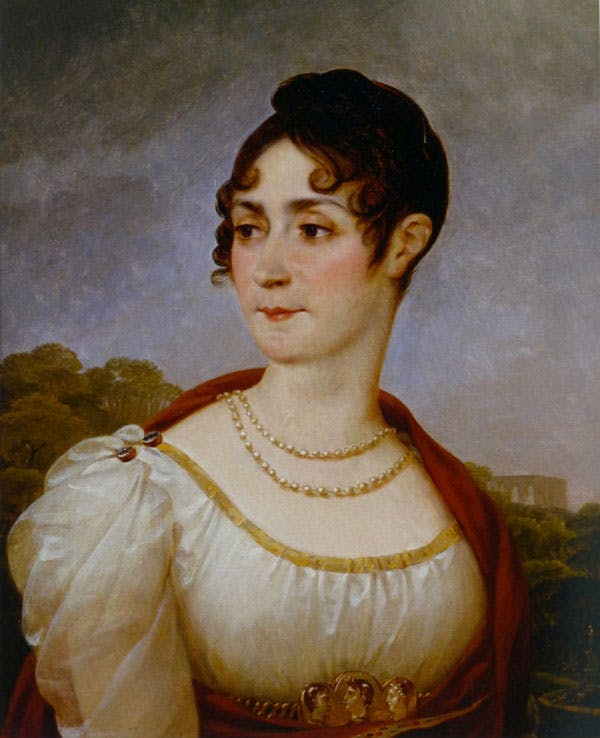
Antoine-Jean Gros, dit baron Gros (1771-1835)
Joséphine de Beauharnais, circa 1809
© DR
This drawing comes from the collection of painter Vincenzo Camuccini (Rome 1771–1844). An admirer of David, Camuccini was a major painter of the Neoclassical movement. He found in the ideas of the Republic a striking correlation with the tragic subjects of Antiquity that fascinated him. Like Appiani and many others, he saw the application of the principles of the Republic as the renewal of his country.
He met Gros in Italy and travelled to Paris in the early 1800s. Between 1814 and 1824, he was inspector of paintings for the Papacy; in 1825, King Ferdinand I of Naples appointed him director of the Academy of Naples in Rome. Vincenzo Camuccini's impressive collection of ancient paintings was largely sold by his heirs to the Duke of Northumberland in 1856. However, albums of drawings remained to be rediscovered, among which was at least one masterpiece: this drawing.
The composition of the painting is brilliant. It reveals the general principle that Gros would later teach to his many students: ‘You must proceed as a whole; a whole of movement, lengths, light and shadow, a whole of effect. You must not, he said, concern yourself with one part without looking at the whole. Are you focusing on the head? Look at the feet, and so on.’
Amidst the smoke of the cannons, Bonaparte has seized the flag and raised it vigorously above his head. Sabre drawn, already moving forward, he turns to his troops to urge them to follow him. His features, sharp as a knife blade, his aquiline nose, his mouth closed in a straight line, his determined air suggest the fearless hero who inspires courage in his soldiers. His tousled, shoulder-length hair, the billowing flag, and the nervous streaks indicate breath and movement; death lurks around him, but Bonaparte does not care: he recklessly crosses the hail of bullets to galvanise his men and make them forget their fear.
This ‘living image of heroism’, as Delacroix put it, was transposed into a painting and purchased by Bonaparte. The success of the painting, exhibited at the Salon of 1801 and since preserved at the Louvre, has never faded. Bonaparte's action at Arcole is one of the rare occasions when Bonaparte stepped out of his role as commander-in-chief to show that he had the makings of a classic military hero, like Bayard or Du Guesclin.
Bonaparte, extremely pleased with Gros' portrait, immediately had it engraved by Giuseppe Longhi so that it could be distributed to the troops and in the gazettes reporting his triumph to the people. From then on, Gros' career was tied to the fate of Napoleon Bonaparte.
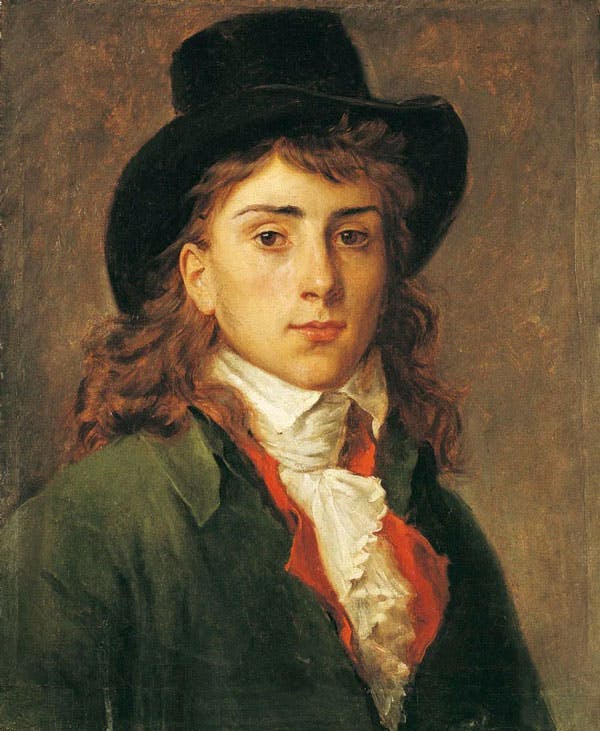
Antoine-Jean Gros, dit baron Gros (1771-1835)
Self-portrait, circa 1790
© DR
Information
Auction
Old Master & 19th Century Drawings
Wednesday, March 25th, 2026 - 5:00pm
Exhibition
March 20, from 11:00 AM to 6:00 PM
March 21, from 11:00 AM to 6:00 PM
March 22, from 2:00 PM to 6:00 PM
March 23, from 11:00 AM to 6:00 PM
March 24, from 11:00 AM to 6:00 PM
March 25, from 11:00 AM to 5:00 PM
Contact
Léa Pailler
Tél. +33 1 42 99 16 50